
8. mai 2026 · 6 min
From Court to Career: Youth, Inclusion and Basketball as a Pathway Forward
(Engelsk versjon av 5.2. Skal videreføres — full tekst nedenfor.)
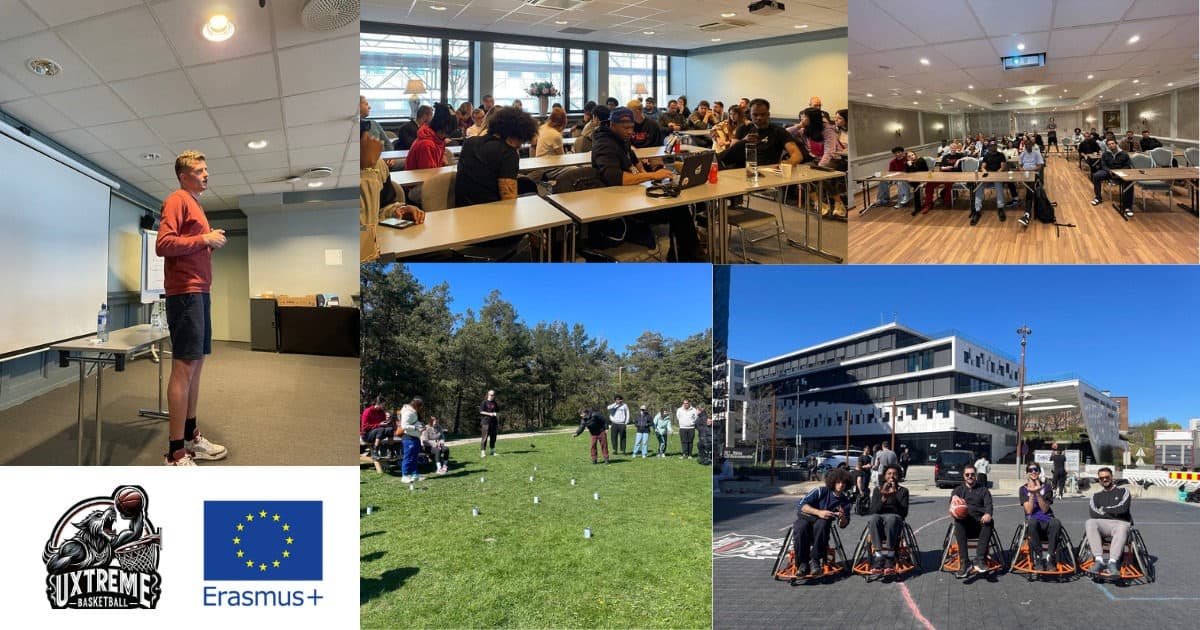
From May 4th to May 8th, Rolvsøy Streetbasketball Club welcomed youth workers from Germany, Türkiye, Finland, Serbia and Bulgaria to Fredrikstad. The visit was part of the Erasmus+-supported project From Court to Career: Youth Skills and Inclusion through Basketball — an international initiative focused on youth participation, social inclusion, sport and future-relevant skills.
An international project with strong local impact
When youth workers from several European countries came to Fredrikstad in early May, it was about much more than a visit. It was about bringing together people with a shared goal: creating better opportunities for young people. Through the Erasmus+ project From Court to Career: Youth Skills and Inclusion through Basketball, Rolvsøy Streetbasketball Club had the opportunity to show how basketball and youth work can be used as powerful tools for development, inclusion and long-term opportunity.
The project brought together participants from Germany, Türkiye, Finland, Serbia and Bulgaria. Over several days, the group worked closely with themes such as Youth Empowerment, Social Inclusion, Skill Integration and Community Impact. The goal was not only to exchange ideas, but to explore how youth work can become stronger, more inclusive and more relevant for the future.
For Rolvsøy Streetbasketball Club, this perspective is essential. Our work is not only about activity in the sports hall or on the basketball court. It is about building spaces where young people are seen, trusted, challenged and given the chance to grow. It is about creating environments where they can experience achievement, develop confidence and discover that they have something valuable to contribute.
Moving from adult-led learning to youth-driven development
One of the most important themes during the seminar was the shift from adult-led learning to youth-driven project development. This is a core principle in much of our work. When young people are only told what to do, they may still learn something. But when they are given real participation, ownership and responsibility, something deeper often happens.
They build confidence. They develop leadership. They become more willing to take initiative. They begin to understand that they can influence both their own lives and the communities around them.
Throughout the seminar, participants could see how this approach works in practice. Instead of seeing young people as passive recipients of activities, they were presented as resources, co-creators and active contributors. That difference matters. For many young people, trust from adults and organizations is what makes them start believing more in themselves.
Real stories from young people who were given a chance
A central part of the seminar was meeting the people behind and around Rolvsøy Streetbasketball Club. Participants got to meet key people from the club and hear strong personal stories from young people who, through the club, had received support, guidance and opportunities they might not otherwise have had.
Some had used that support to develop their own ideas and become entrepreneurs. Others had found their way into coaching, volunteering, or taking on meaningful roles in the club environment. For some, it was simply about having something positive, safe and meaningful to look forward to in everyday life.
This is exactly why projects like this matter. They show that youth work does not have to be abstract or distant. It can be very concrete. It can be a place to belong. A person who believes in you. A safe environment where you are allowed to try, fail, learn and move forward.
Youth workers as a valuable force in the local community
During the seminar, participants also explored how youth workers can be a valuable resource in the local community. This was not just discussed in theory. Rolvsøy Streetbasketball Club demonstrated how trust, responsibility and community can give young people the opportunity to grow, contribute and create positive change for others.
When young people are given responsibility in a club or organization, much more happens than simply "helping out." They develop skills. They build relationships. They learn ownership. And in many cases, they become role models for others.
This is also a key part of the From Court to Career approach. Basketball and sport are not only activities in themselves. They can become gateways to much bigger things: leadership, education, work, volunteering and the experience of having something meaningful to contribute.
Basketball, AI, sustainability and entrepreneurship
One of the most exciting parts of the gathering was the exploration of how sport can be connected with other fields that are highly relevant for the future. Throughout the seminar, participants examined how basketball, physical activity, artificial intelligence, sustainability and entrepreneurship can be combined to provide young people with practical skills that matter in today's world and in tomorrow's labor market.
This is an important part of how youth work needs to evolve. Young people do not only need activities. They also need spaces where they can build competence, understand how the world is changing, and experience that the skills they are learning are valuable beyond sport.
By connecting basketball with entrepreneurship, technology and social awareness, learning becomes more relevant. It also helps young people see more possible pathways ahead. Basketball may be the starting point, but it can also become a bridge to education, project work, employment, social engagement or independent initiatives.
International cooperation that builds bridges
The professional content of the seminar was important, but so was the opportunity to build relationships across borders. When people with different backgrounds, experiences and cultures come together around a shared purpose, new ideas and new perspectives often emerge. That happened here as well.
Through cooperation, experience-sharing and intercultural exchange, new networks, new ideas and new opportunities for future collaboration were created. This is one of the great strengths of international projects. Their value does not end when the seminar is over. In many ways, that is only where the next phase begins.
When organizations from different countries find common language and shared goals, this can lead to new partnerships, new projects and even stronger youth work in the future. For us, that is a vital part of international cooperation: building bridges that last.
More young people need the chance to try
An important reason behind this project is that many young people today do not always get the chance to explore their ideas, test themselves, or work toward their dreams. This is something many organizations know well. Some young people lack support. Some lack safe spaces. Some lack adults who truly see them. And some simply lack that first opportunity.
This is something we want to help change.
During the seminar, youth workers from other countries were able to see how Rolvsøy Streetbasketball Club actively uses young people, youth workers and volunteers as resources in both the club and the local community. It is about seeing potential, not only need. It is about highlighting strengths, not only challenges.
By sharing our experiences and methods, we hope to inspire other clubs and organizations to create similar opportunities for young people in their own communities. If more people are willing to give young people responsibility, trust and space, a great deal of positive change can grow from that.
Thank you to everyone who contributed
Finally, we want to thank all participants who brought energy, knowledge, perspectives and commitment to Fredrikstad during these days. Gatherings like this do not become meaningful on their own. They become meaningful because people show up, share, listen, learn and build something together.
From Court to Career is a strong example of how international cooperation can become something concrete, relevant and valuable. Not only for the organizations involved, but for young people, local communities and the future of work.
This is exactly the kind of cooperation we believe in. Cooperation that builds people. Cooperation that builds communities. And cooperation that gives young people more real opportunities in life.